
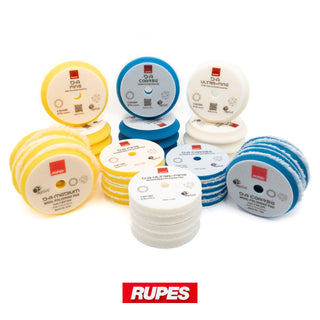

Start With Paint Condition, Not Pad Choice
Rupes polishing pads are color-coded by cut level — how aggressively each foam type abrades the clear coat. But the right pad depends on where your paint is starting from. Use a pad that's too aggressive and you'll leave micro-marring to refine out. Use one that's too mild and you won't move the defects at all. Inspect the paint under bright light before choosing a pad.
The Rupes Pad Color Guide
- Yellow (Coarse Cutting) — For heavy oxidation, deep scratches, and leveling wet-sand marks. Cuts fast and needs a refining pass to follow.
- Orange (Medium Cutting) — The workhorse pad for most enthusiast correction jobs. Handles moderate swirls, water spots, and light scratches without leaving heavy marks behind.
- White (Polishing) — Lighter cut for refining after an orange pad, or as a first step on soft European paint that responds quickly.
- Blue / Green (Finishing) — For final gloss and clarity after any cutting step, or to apply ceramic coatings and finishing wax with maximum surface contact.

Matching Pad to Compound
The pad and compound work together. Changing one without adjusting the other changes your results. A practical starting framework:
- Yellow + coarse compound — Maximum correction. Always follow with at least one refining pass.
- Orange + medium compound — Best all-around combination for correction without excessive aggression.
- White + light polish — Refinement after orange, or single-step on soft clear coats.
- Blue/green + finishing polish — Final clarity step before coating or LSP application.
When in doubt, start less aggressive and work up. You can always increase cut; it's much harder to fix micro-marring left by an overly aggressive combination.
Pad Size and Machine Pairing
Rupes pads are sized for specific machines. 3-inch pads pair with the Rupes Nano for tight areas. 5-inch and 6-inch pads are standard for the LHR 15 (15mm throw). 6-inch and 7-inch pads pair with the LHR 21 (21mm throw). Larger pads cover more paint per pass but require more attention around trim and body lines.

Keeping Your Pads in Condition
A clogged pad cuts less efficiently and can scratch. Use a pad cleaning brush every few passes during polishing to clear compound buildup. After each session, hand-wash pads with mild soap, rinse thoroughly, and air-dry face-up. Store them flat — stacking pads under weight deforms the foam over time. Replace pads when they no longer return to their original shape after compression or when the foam tears.